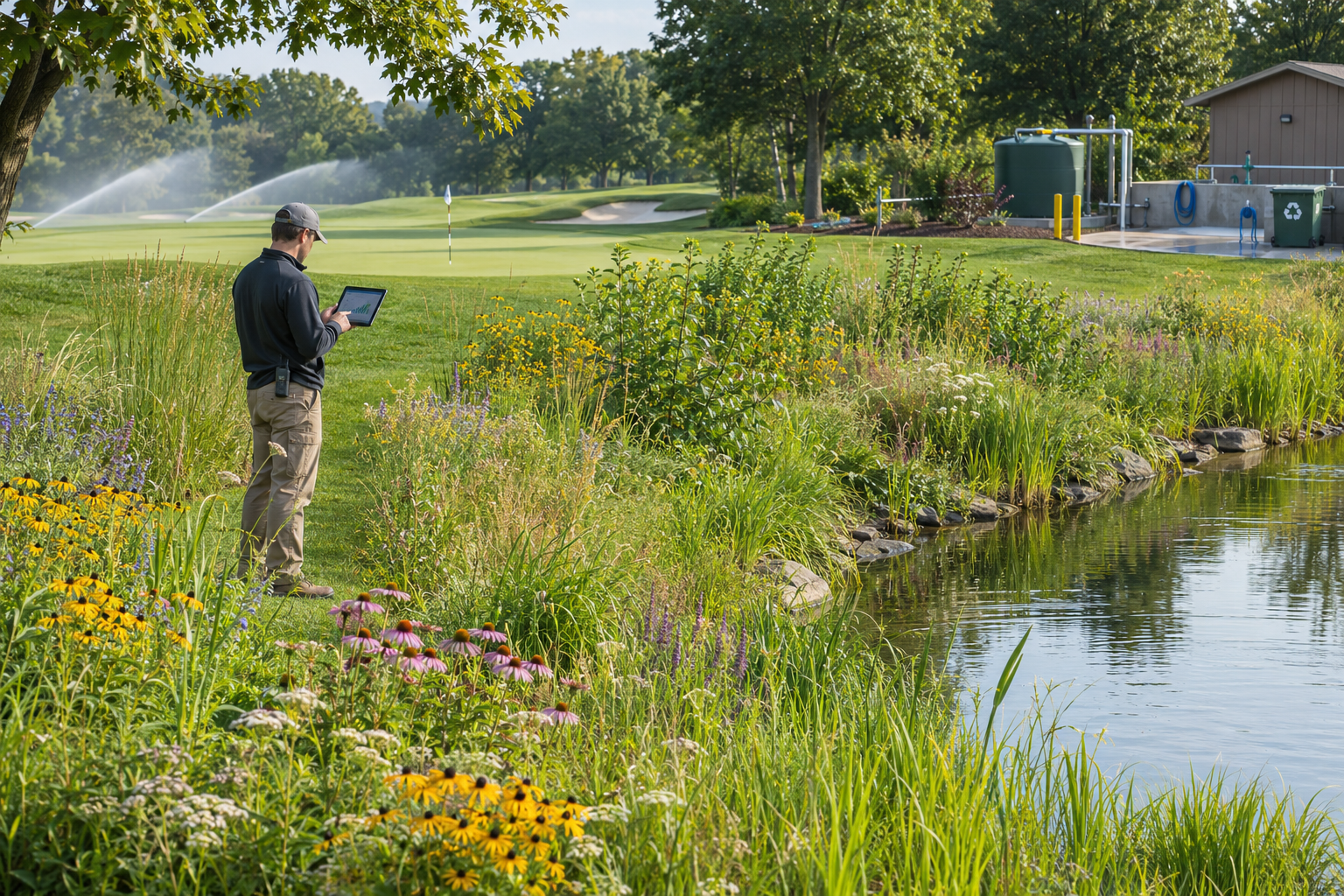
The Golf Course Superintendents Association of America has named the recipients of its 2026 Environmental Leaders in Golf Awards. Across four categories, the recognised work covers staff education, water management, waste recovery, automation, habitat and community engagement.
Awards naturally highlight positive examples, and the figures in GCSAA’s announcement are reported by the association and participating facilities rather than independently audited in the release. Even with that qualification, the programme provides useful operating examples because it connects environmental goals with specific course practices.
Communication and outreach
Ken Kleinedler of Collier’s Reserve Country Club received the Communications and Outreach award. GCSAA highlighted staff training, member and community communication and educational activity. The lesson is straightforward: environmental work has more value when the people using and maintaining the property understand what is being done and why.
For a turf team, that can mean briefing staff on buffer zones and wash-down procedures, explaining seasonal presentation changes to golfers, or showing local groups how managed turf, native areas and water bodies interact. Communication is not an accessory to the programme; it helps protect it when visual standards or work practices change.
Land stewardship and waste
Carl D. Thompson of Columbia Point Golf Course received the Healthy Land Stewardship award. The recognised programme included pollution prevention, waste management, composting and recycling. These are often dispersed across maintenance operations, which makes ownership and measurement essential.
Facilities can begin by mapping waste streams: green waste, clippings, sand, cores, packaging, oils, batteries and wash water. Each stream needs a defined destination, responsible person and record. The operational benefit is greater control over risk as well as a clearer account of disposal and reuse.
Conservation through data and automation
James B. Sua of Pei Tou Kuo Hua Golf & Country Club in Taipei received the Innovative Conservation award. GCSAA reported a 30 per cent reduction in water use following usage analysis, a 20 per cent improvement in maintenance productivity through automation and a 30 per cent reduction in landfill waste. The club also held a community event attended by 180 people.
The combination is important. Data identifies where resources are going; automation changes how selected work is delivered; waste management addresses the outputs; outreach connects the programme with people beyond the maintenance facility. None of those elements needs to stand alone.
Natural resources in daily infrastructure
Harold Ammons of Flat Creek Golf Club received the Natural Resource Conservation award. GCSAA cited irrigation auditing and upgrades, buffer zones, improved wash-area drainage, energy efficiency and habitat and pollinator work.
This is sustainability expressed through ordinary infrastructure. An irrigation audit can reveal distribution problems. A buffer can reduce the chance of product reaching water. Correct wash-area drainage controls a concentrated risk. Habitat work can be planned around the playing footprint rather than treated as a separate project.
Turning examples into a programme
The four recipients do not present a single model for every course. They do suggest a repeatable sequence: identify the material environmental risks, establish a baseline, assign responsibility, make a practical intervention and record the result. Communication then gives staff, golfers and the wider community a way to understand the work.
For facilities beginning the process, a small verified improvement is more useful than a broad claim. Meter one irrigation area. Audit one wash pad. Track one waste stream. Document one habitat zone. The award-winning programmes show how those operational disciplines can accumulate into a credible environmental position.
Source: GCSAA announcement, 10 November 2026.