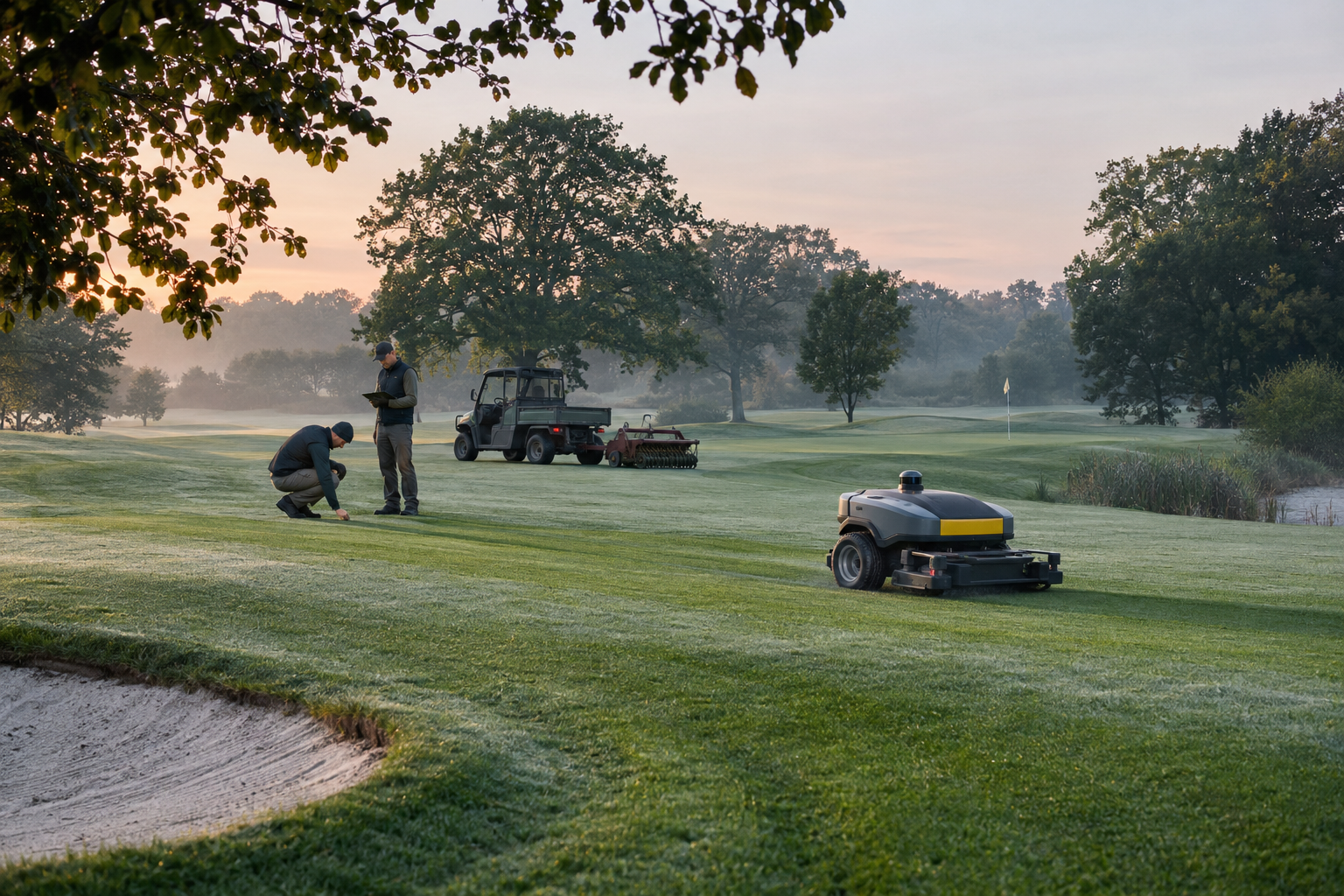
Formby Hall Golf Resort & Spa has invested approximately £750,000 in course machinery over the past year, combining robotic mowing and automated ball collection with a new Toro fleet. The equipment supports the resort’s 18-hole Old Course and nine-hole Woodhey Dunes course.
The number attracts attention, but the more useful story is the composition of the investment. Formby Hall has not treated autonomous equipment as a complete substitute for conventional machinery. It has placed repeatable automated tasks beside a fleet intended for the skilled, variable work that still depends on operators.
A mixed-fleet decision
GreenkeepingEU reports that the programme includes robotic mowers, automated range ball collectors and new Toro equipment. The resort says the changes have improved fairway quality and consistency while freeing staff for other course priorities. Those outcomes are the facility’s own assessment; no independent performance data was published with the report.
Even so, the operating logic is recognisable. Large, regularly defined areas can consume many staff hours when they are mown on a conventional schedule. If autonomous units can maintain those areas reliably, the team can redirect time toward presentation details, irrigation work, agronomy, repairs and jobs where observation and judgement matter more than repeated passes.
Automated ball collection applies the same principle in a different setting. Removing a routine driving task can improve the availability of staff, particularly during busy periods, without pretending the entire range operation runs itself.
The work behind the machines
A mixed fleet introduces new management demands. Autonomous units need suitable boundaries, safe routes, charging arrangements, recovery procedures and clear ownership when alerts occur. Conventional machines still require daily checks, sharpening, servicing and trained operators. The value comes from coordinating both systems, not merely buying them.
Facilities considering a similar approach should calculate the labour profile of each task before choosing a machine. How many hours are currently spent mowing the proposed area? When do those hours occur? What other work is deferred? How much technician time will the new units require? What happens during prolonged wet weather, course projects or changes to mowing lines?
It is also worth measuring the result in turf terms rather than machine utilisation alone. Consistency, clipping management, wear around access points, presentation at boundaries and the response of the surface should all be tracked. A robot that logs many hours is not automatically improving the course.
A practical signal for the market
Formby Hall’s investment illustrates where fleet planning is heading. The decision is no longer simply between labour and automation or between one manufacturer and another. It is about allocating each job to the most appropriate combination of people, autonomous equipment and operator-led machines.
That makes workforce planning part of capital planning. A facility that understands which work needs skilled attention can use automation to protect that attention. A facility that buys first and redesigns the workflow later risks adding complexity without releasing meaningful capacity.